Are bluetongue-infected midges on the way from the UK?
If weather conditions allow the migration of infected midges from the UK across the Irish Sea to Ireland this autumn, we could see increased cases of bluetongue here.
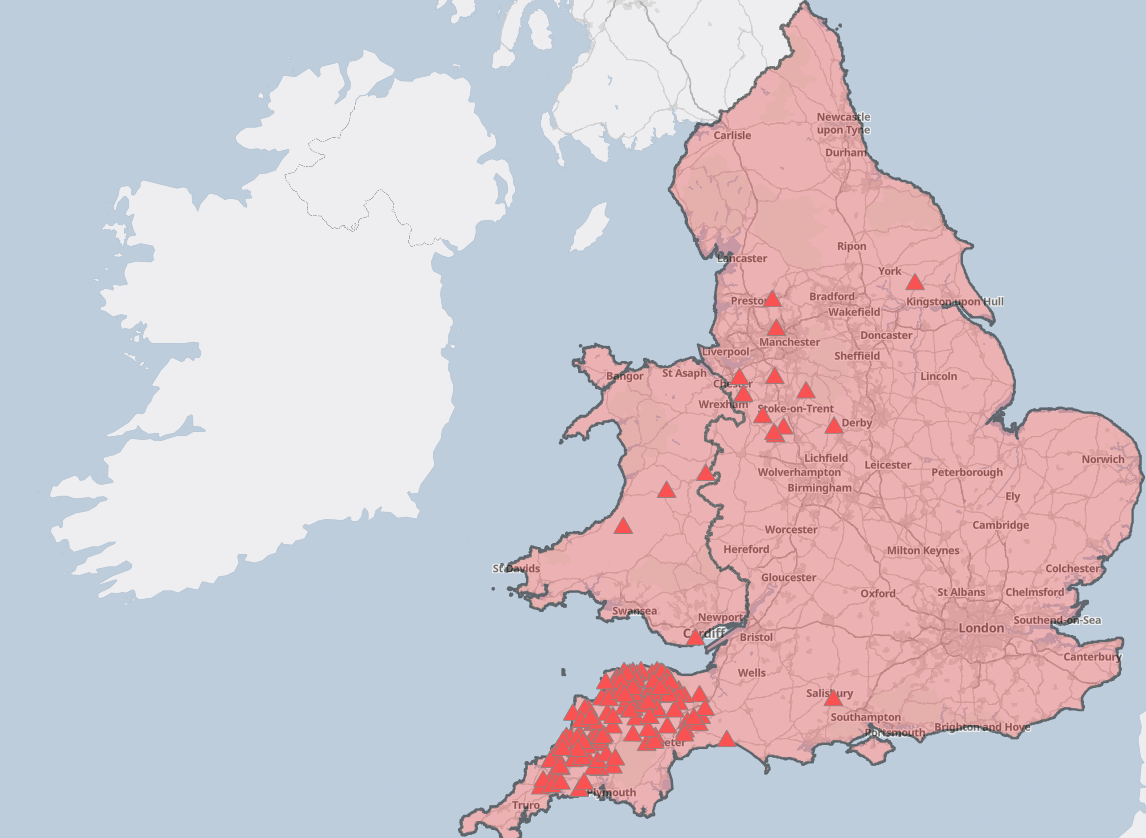
According to the National Disease Control Centre (NDCC) in Ireland, there has been a significant increase in the number of bluetongue cases with clinical signs in Great Britain, particularly in south-west England and Wales, since the beginning of July 2026.
Most of the cases have been confirmed in the last week with a high number located in Devon, Somerset and Cornwall.
Confirmed bluetongue BTV-3 cases since July 1, 2026. Source: DEFRA and APHA
By species, the herds/flock affected are sheep (majority), cattle and one llama.
There is currently no information available at this stage about the vaccination status of these herds/flocks.
The clinical signs more frequently described are:
In sheep – swollen face/lips, lesions (ulcers, erosions) in mouth (with drooling), lameness (swollen coronary bands observed), lethargy, fever and some mortality;
In cattle – crusting of the muzzle and teats, lesions (ulcers) in mouth, lame and stiff limbs and fever.
Bluetongue in Ireland
The first case of BTV-3 (bluetongue) was confirmed in a suckler herd in Co. Wexford January 24 this year.
Detection of BTV antibodies in a clinically healthy cow at slaughter as part of the Department of Agriculture, Food and the Marine (DAFM) surveillance led to detection of positive animals in the herd of origin.
No clinical signs had been noted in these animals and epidemiological investigations were conducted and BTV-3 was confirmed in other cattle herds.
According to DAFM, the likely source of the incursion of the disease in the country was by infected midges blown across the Irish Sea in late autumn 2025.
To date, surveillance has identified bluetongue in additional herds in the following counties: Wexford; Wicklow; Louth; Laois; Monaghan; Kildare; Cork; and Tipperary.
Investigations indicate these cases are historic from last autumn and no clinical signs were noted in any of the herds.
Midges risk
Temperatures have been sufficiently high for midges that were infected last year and survived the winter to become infectious now, according to the NDCC.
However, no active infection (new cases infected this season) have been confirmed during this high-risk period to date.
If weather supportive of midge migration across the Irish Sea from England and Wales, similar to those which enabled the spread of bluetongue to Ireland last autumn, there is a possibility of infective midges again being blown across the sea from the areas where active infection is present in the UK.
Vaccination
As the risk of bluetongue transmission is now increasing with the warmer weather and possibility of incursion from England/Wales, the department is advising that any farmers who have not yet vaccinated stock should strongly consider vaccination.
Vaccination courses should be completed in sufficient time for animals to develop immunity; approximately six weeks for cattle and three weeks for sheep.
Vaccination can reduce the risk of economic losses and further spread of the disease.
DAFM has outlined that vaccination of breeding animals is especially important given BTV infection affects fertility (infertility, early embryonic death or abortion) and the virus can be transmitted in semen during mating.
BTV-3 (bluetongue) inactivated vaccines are permitted in Ireland under licence.
Farmers who are interested in vaccination are advised to discuss the options with their private veterinary practitioner (PVP).
Related Stories
Are bluetongue-infected midges on the way from the UK?
Bluetongue cases in Britain surpass 70 in just one month
‘Not too late’ to vaccinate against bluetongue – DAFM
.editor-styles-wrapper .wp-block-acf-related-stories-block { max-width: 960px !important; background-color: var(--color-gray-default); padding-inline: 40px; padding-top: 8px !important; padding-bottom: 20px !important;
Source: Agriland. Summary reproduced for informational purposes.
Related
 Agriculture
Why silage testing is a smart investment
When farmers are drawing up fodder budgets this month, it may be well worth their while to silage test the crop already in the yard. Despite the drought impacting fertiliser applications, a lot of farms will be hoping to get another cut in at the end of the mo
 Agriculture
Country diary: Wensleydale sheep have their day in the sun | Andrea Meanwell
Garstang, Lancashire: With fedora and broken shepherd’s crook, I was a judge at an agricultural show, inspecting the mouths and fleeces of some fantastic breeds As I walked across the show field in the sunshine on my way to the secretary’s tent, my shepherd’s
 Agriculture
After decades of decline, New Zealand’s wool industry is making a comeback
Forty years ago there were more than 22 sheep to every New Zealander, but wool prices and production declined with the uptake of synthetic alternatives John Hargreaves’ family has farmed sheep and beef in Kaiwaka, north of Auckland, for generations. In the 196
 Agriculture
Heatwaves impact winter and summer crops across Europe
Recent heatwaves have severely impacted many winter and summer crops growing across Europe, according to Brussels. In essence, the continuing dry weather shortened the grain-filling phase of winter crops and brought forward the harvest, which has already been
Never miss a headline
The biggest stories in business and finance, delivered to your inbox. Join thousands of readers — unsubscribe any time.