No cost of living payment for NI until Stormont budget agreed, says Bryant
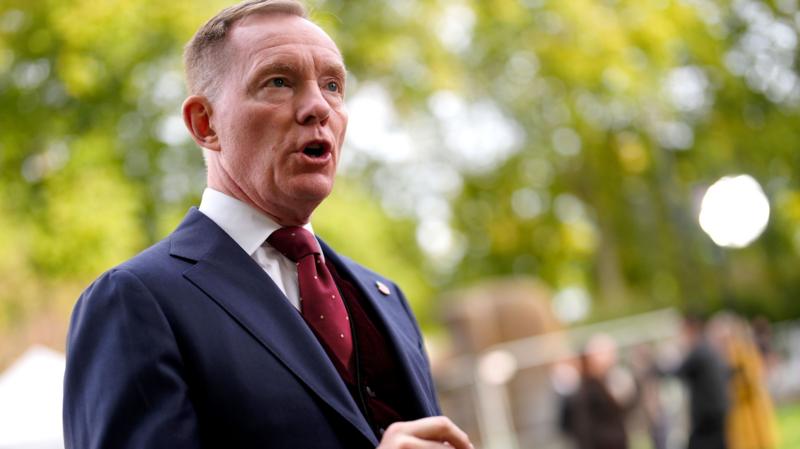
The secretary of state has warned that a cost of living payment cannot be made in Northern Ireland until an executive budget is agreed.
It comes after the Chancellor John Healey announced the £100 payment for households in England, based on how much council tax they pay.
Delivering his first Budget, Healey said money would be made available to Stormont to fund an equivalent scheme.
However Sir Chris Bryant said Stormont would not be in a legal position to deliver the money without a budget.
Seven months into the financial year the Northern Ireland Executive has still not agreed a budget.
Stormont ministers say the UK's devolution funding formula no longer delivers enough for them to produce a balanced budget.
Sir Chris has offered them an additional £525m this year but they said it is still inadequate.
Stormont ministers will have to agree a budget if they want to access the funds announced at the UK budget, but it is up to them if they wish to use that money for such an energy scheme.
Finance Minister John O'Dowd indicated his preference would be to fund an equivalent scheme, which would cost just under £90m.
The administrations in Scotland and Wales have said they intend to implement their own schemes.
Northern Ireland does not have council tax so another mechanism will have to be used to identify who gets the payment.
Stormont officials have recent experience of designing similar payments, such as the home heating oil voucher scheme.
Overall, Northern Ireland will get an additional £270m for public services as a result of the Budget, of which £131m can be used this year.
All households can also expect to get further help with their electricity bills.
Last month, households in NI got £63 off their bill as the local outworking of two schemes which apply in Great Britain, which has a separately regulated electricity market.
Part of that discount related to a temporary VAT cut on bills in GB, which is being extended.
The Treasury said it was "providing funding for the Northern Ireland Executive to provide comparable support with household electricity bills."
The intention is to apply the VAT cut in NI from April 2027, bringing it in line with the rest of the UK.
The government is also removing a 4% tariff, or import tax, on heating oil imported to NI from outside the EU.
EU produced heating oil is already zero tariff.
That moves potentially matters more in NI than other parts of the UK as oil is still the predominant heating fuel in NI.
However, in practice, it is likely to make little difference to consumer prices in the short term but could open up the market to wider sources of supply.
Millions to get £100 energy payment after Budget as OBR says disposable incomes unlikely to grow
The government is also providing £1m for an investment summit in Northern Ireland to "highlight Northern Ireland's potential as the only place in the world with dual access to the UK internal market and EU market".
A similar event was held in Belfast in 2023 .
There is also a £7.5m investment for Queen's University Centre for Secure Information Technologies (CSIT).
It is a centre of excellence in cyber security which has close links to the UK National Cyber Security Centre, a part of GCHQ.
Stormont gets a population-based share of additional spending allocated to public services in England.
Stormont's Department of Finance will make its own calculations of when that money can be spent and what it can be spent on.
Finance Minister John O'Dowd said the Budget would "bring cold comfort to workers' families and indeed businesses out there who are struggling under a huge cost of living crisis".
Addressing reporters, he said the package on offer was not enough to allow Stormont ministers to agree their own budget.
"There remains a significant gap between the funding required by the executive to deliver front-line public services; pay our public sector workers the pay uplifts they deserve and grow our economy than that was put on the table today by the British government."
O'Dowd reiterated that compared to Scotland and Wales, Northern Ireland was funded below its level of need and he called for "further engagement" with Westminster on the issue.
Colin Neill, chief executive of Hospitality Ulster, said measures introduced to support hospitality elsewhere in the UK should generate additional funding for NI through the Barnett formula - the measure used to work out how much money the UK government sends to devolved nations each year.
"It is essential that this money reaches our sector," Neill said.
"The government cannot continue to raise wages without addressing the excessive taxation of the hospitality industry which is now over 40%."
Glyn Roberts, from Retail NI, said small businesses in Northern Ireland should be given the same support as their counterparts in England.
"Our High Streets have the highest vacancy rates in the UK, at 25%."
He added that the executive must use the additional funding to "prioritise small business rates relief, support independent retailers and help tackle the growing high street vacancy crisis".
Leo Slevin, from Belleek Men's Shed in County Fermanagh, said the village was a deprived area and in real terms the Budget did not offer much help to people.
"The home heating oil today is about £1.28 or £1.25 a litre," he said.
"So £100 will not scratch the surface of putting any heat, unless it's coming every month to people. It'll make no difference on a yearly basis - absolutely none".
Sue Deacon is a volunteer at Belleek hub, a community centre in the village.
She thinks the pension income tax change will offer a small relief for pensioners.
"I'm pleased to see any help that they can get us," she said.
"Because my fear is that with the pensions, the allowance staying the same, if pensions rise a lot more pensioners will be paying tax and they shouldn't have to pay tax on a state pension."
Hugh Ferguson is retired and said the challenges of living in a rural area with little money makes things difficult for pensioners in Belleek.
"Because we're a rural area, and we're a long way from a major centre, we spend a lot on fuel, driving back and forth, so that's difficult, with the prices going on," he said.
"And that's more than doubled, but of course, our incomes haven't doubled, so it's very difficult for us."
Christina Taylor owns Shed Bistro in south Belfast and employs about 30 staff.
Speaking ahead of the Budget announcement, she said an additional rise in the minimum wage would mean higher prices for customers. The legal minimum wage is to rise by 3.9% in April .
"The raise last year meant that every guest would need to spend £4.50 more to cover that," she said.
"That's so much money and people can't afford that.
"Raising the minimum wage isn't the answer to the cost of living because it goes in a circle and no-one is better off."
Taylor added that there "needs to be support for households or else eating out will be a thing of the past".
'Shortchanged' or 'fighting chance': Views differ as NI secretary meets parties on budget
Health workers run out of patience with Stormont budget delay
Source: BBC News. Summary reproduced for informational purposes.
Related
 Economy
Bank of England raises interest rates to 4%, the first increase for more than three years
Base rate increases from 3.75%, and Bank governor signals another rise in near future to combat rising inflation Analysis: Interest rate rise in midst of cost of living crisis will leave many incredulous Business live – latest updates The Bank of England has r
 Economy
Rural voters were feeling left behind before the midterms, poll shows
Polling done for the Guardian shows plummeting support from a former key constituency of Donald Trump’s base Polling conducted by the Harris Poll for the Guardian before the election shows just how angry voters were and points to one key reason Republicans los
 Economy
Thursday briefing: ‘A dignified life for all must be the north star’: economist Isabella Weber answers your questions
In today’s newsletter: From the cost of living to the AI bubble and the fight against fascism, Weber answers Guardian readers’ questions on how to build a fairer economy and world Good morning. As stateside celebrations die down, the Democratic party will be f
 Economy
The RBA says there is ‘excess demand’ in the economy. Households doing it tough might disagree | Greg Jericho
The problem with inflation driven by factors such as wars and supply side shocks is that interest rate rises don’t do much Get our daily political email , free app or daily news podcast On Tuesday this week came the biggest news regarding inflation. No, not th
Never miss a headline
The biggest stories in business and finance, delivered to your inbox. Join thousands of readers — unsubscribe any time.