Trump imposes 15% tariff on key chip material to counter China
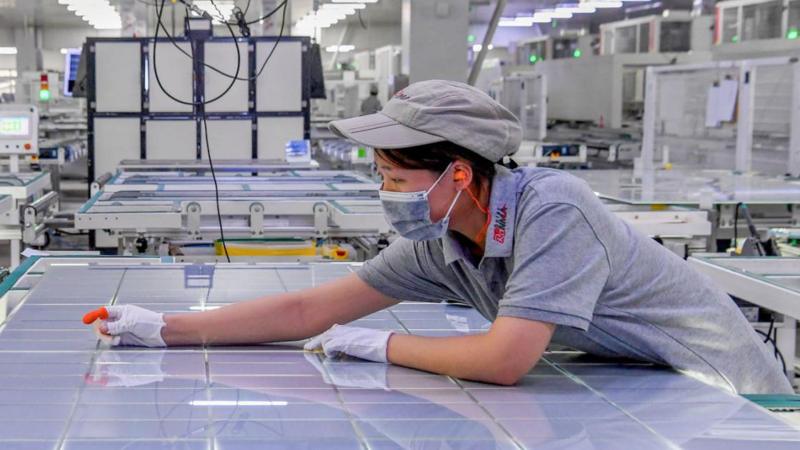
US President Donald Trump signed an executive order on Thursday that imposes a 15% tariff on imported products made from polysilicon, a crucial material used in semiconductors and solar panels.
The order also set minimum import prices on polysilicon and related products. It comes after a national security investigation into the production of the material overseas.
The move is intended to help protect US manufacturers as they face increasing competition from China's chip industry - a key source of friction between the world's two largest economies.
The Chinese embassy in Washington said the move "seriously disrupts" trade between the two countries and Beijing will act to protect its companies.
Washingtom is "abusing state power to go after Chinese businesses," the embassy said, adding that protectionism will not make the US more competitive.
Trump said in the order , external that he had accepted recommendations by Secretary of Commerce Howard Lutnick to set minimum import prices as well as a 15% tariff on polysilicon and related imports.
The measures are due to take effect in December.
The US will also offer incentives to boost domestic production, it added.
For decades, the US has allowed "foreign firms to weaken United States producers in the polysilicon sector," said Trump, who has long advocated for the use of tariffs to protect American jobs and boost the economy.
The material is critical in military equipment and electronics, yet imports have led to the US' share of global polysilicon production to fall from 50% in 2005 to less than 2% in 2024, Trump said.
China holds a near monopoly on the production of polysilicon.
The order is likely to benefit Hemlock Semiconductor and Wacker Chemie, which are the main producers of the material in the US.
The production of computer chips is central to the race between the US and China to develop artificial intelligence (AI). Washington and Beijing have also been locked in a tit-for-tat tariffs war, which has been on hold since May 2025.
Analysts quoted by Chinese state media outlet Global Times said the new tariff marks the latest escalation in Washington's efforts to limit China's role in critical technology supply chains.
The move follows other US restrictions on the imports of drones, humanoid robots and other tech products from China.
China announced a range of countermeasures this week, including tighter export controls on drones. Beijing also launched a national security review into imported printers and copiers.
Trump administration pays back $100bn in 'Liberation Day' tariffs to businesses
Source: BBC News. Summary reproduced for informational purposes.
Related
 Business
July’s heatwaves kept UK shoppers away from high street
Visits down 3.8% after 6.2% fall in June, with many choosing to buy online instead, research for retail body finds Shoppers stayed away from UK high streets during last month’s heatwave temperatures , with many choosing to buy online instead as the mercury in
 Business
Meta fined $567m in largest child safety ruling against social media giant
The ruling is in addition to $375m in fines Meta was already ordered to pay in the case, for a total of $942m.
 Business
Why airlines are warning over lithium-ion batteries
The airline industry wants passengers to be careful when travelling with lithium ion batteries.
 Business
Argos is getting a makeover - but can it attract new shoppers?
The retailer has been around for 50 years but struggled to compete with newer rivals such as Amazon. Can its new owners turn it around?
Never miss a headline
The biggest stories in business and finance, delivered to your inbox. Join thousands of readers — unsubscribe any time.