When is the optimal time to harvest forage maize?
This year’s forage maize harvest could well be one of the earliest on record.
In contrast to cereals, maize is a deep rooting crop. It is well capable of finding moisture at lower levels within a soil profile.
And, of course, heat is that all-important driver of maize performance.
There is also strong evidence confirming that crops established under film will get that better start, making their ability to withstand periods of extremely dry weather all the stronger.
But when is the optimal time to actually harvest forage maize?
Maizetech’s Robert Duncan recently took time out to walk crops growing on his own Co. Antrim farm in order to highlight the steps that should be taken to fully capture the potential of maize at harvest time.
His most advanced crops should be ready for the silo within the next fortnight.
Duncan commented: “Growers should pay little or no attention to cobs on the outside of a crop.
“This is because they have been exposed to all the sunshine that has hit that location over the previous week.”
According to the Maizetech representative, the “real test” is assessing what is happening within the crop itself.
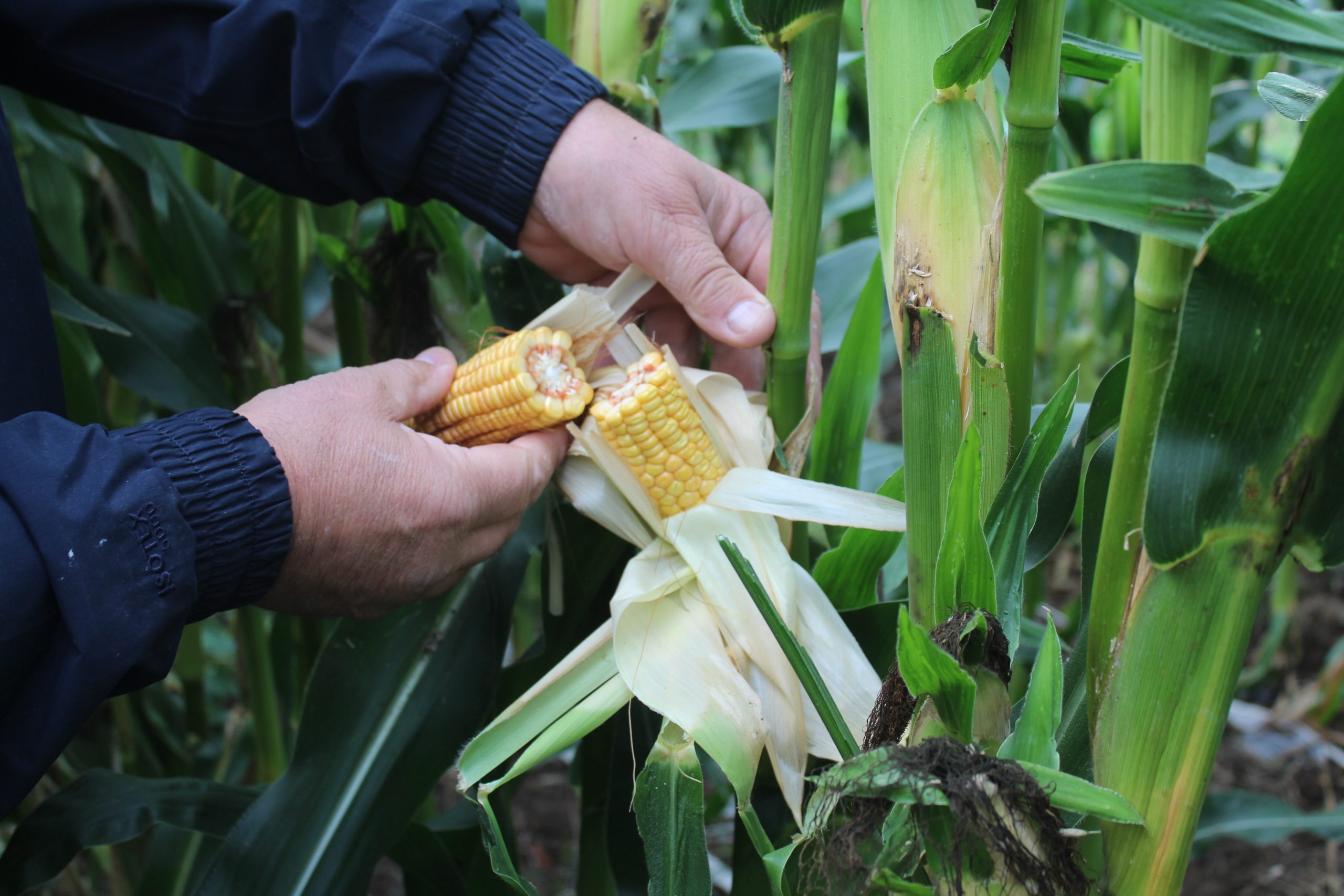
“So, it’s very much a case of walking into the crop and finding an average cob that represents what’s really going on.
“The principle or top cob should be selected: this is the one that should be judged.”
When assessing the crop, the first order of business is to peel back the sheath and expose the grain.
Duncan explained: “When a crop is fully dried out, the inside leaf touching the kernels should feel like tissue paper.
“At that stage the dry matter should exceed 30%. This will also coincide with the plant having stopped transferring sugars into the cob.”
Once a cob has been initially inspected, it should be broken in half. It is then a case of taking an individual kernel and squeezing it.
Duncan continued: “You do not want to see any moisture coming out of the seed at that stage.
“In my own case, crops of the Pioneer 7034 variety should be ready for harvest in two weeks’ time.”
Dent or flint
According to Robert Duncan, varieties of forage maize come in one of two categories: dent or flint.
He explained: “In a dent variety, the starch within it is available almost immediately from a fermentation perspective.
“In other words, silage made from dent maize varieties could be ready for feeding within a week of cutting.
“Full digestibility of the starch within the crop would be achieved within that time period.”
According to Duncan, where flint varieties are concerned, digestibility will be “that bit slower”.
“We could be talking three or four weeks.
“So anyone wanting to start feeding maize early in the season, the option there would be to place forage made from dent maize varieties at the front of the pit,” he said.
Varieties
Maize growers are becoming much more aware of the varieties now available to them.
“The 7034 variety has been a phenomenal success in this part of the world,” the Maizetech representative confirmed.
He added that the dent varieties, on the whole, will be slightly later maturing than their flint counterparts.
Duncan said: “For many years dent varieties of maize were not available in Ireland.
“However, Pioneer has done a lot of work in developing earlier maturing dent varieties that perform well under Irish growing conditions.
“This is the third year that 7034 has been available in Northern Ireland. And farmers have fully recognised its value as a very high-performing maize variety.”
Robert Duncan points out that the key criteria to be met in determining the harvest date of a maize crop are: full maturity in terms of starch content; and 30% plus dry matter in tandem with plants that are not fully desiccated.
He added: “It’s very much a case of maximising the digestible fibre levels within the plant as a whole.
“Years ago when we were working without plastic, it was a case of leaving maize crops in the ground until November.
“At that stage you would have
Source: Agriland. Summary reproduced for informational purposes.
Related
 Agriculture
How pig farmers can benefit from growth of hybrid rye production in Ireland
The use of native grown hybrid rye in pig diets has increased in recent times, with the quantities available for feeding seem set to increase in the years to come. According to Teagasc, the area set to winter rye in Ireland for 2026 is projected to be 5,000ha
 Agriculture
Welsh father and son make history at Sheep Dog World Trial
A father and son from Wales have made history after both were crowned world champions at the Sheep Dog World Trial 2026 in Scotland. David Howells, from West Glamorgan, won the world title with his dog Wyverne Pip, while his son, Jack Howells (19), took the Yo
 Agriculture
Carbery increases milk price for August
Carbery Group has announced its milk price for August. Carbery has increased its base milk price by 1c/L for the month of August. The additional 0.5c/L support payment introduced in July in recognition of challenging weather conditions will remain in place for
 Agriculture
Thai poultry audit sparks call for robust import controls
The Ulster Farmers’ Union (UFU) has called for import standards to be upheld after concerns were raised about poultry controls in Thailand. The comments follow the findings of a recent European Commission audit into Thailand’s poultry export system. The audit,
Never miss a headline
The biggest stories in business and finance, delivered to your inbox. Join thousands of readers — unsubscribe any time.