New Zealand milk production reaches record high
New Zealand’s milk production has grown by around 3.5% for the 2025/2026 season, according to the country’s latest dairy statistics report.
The national dairy herd produced 21.8 billion litres of milk last season, a 3.5% increase on the 2024/2025 season, where production totalled 21 billion litres.
The production was achieved off 4.72 million cows, which is also a 1% rise on the 2024/2025 figures.
When processed, the 21.8 billion litres of milk produced equated to 2.02 billion kilograms of milk solids, a 4.5% on the previous season.
Breakdown
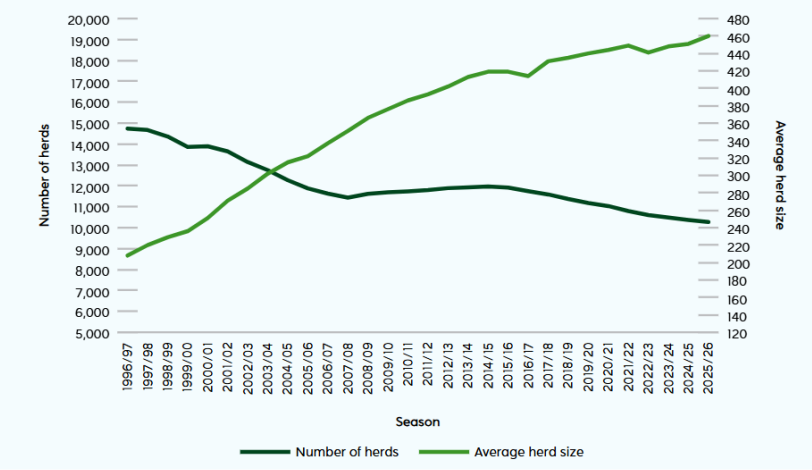
According to the report, the average herd size now sits at 460 cows/herds, a nine cow increase on the year prior.
61.1% of theses cows are Jersey/Friesian cross breeds, 23.3% are Holstein Friesians, 7.6% are Jerseys, while the further 8% is made up of other breeds such as Ayrshire.
The report also highlighted that dairy herds fell by 102 over the year, with 10,268 herds now operating across the islands of New Zealand.
Number of herds and average herd size over the years. Source: New Zealand Dairy Statistics Report comprised by LIC and DairyNZ
According to the report, 6% of all herds now have more than 1,000 cows, while 17% have more than 700 cows.
However, there is still less than 400 cows on 53% of all New Zealand farms.
Only 1.5% of farms have fewer than 100 cows, and just over 13% of farmers have less than 200 cows in total.
Distribution does vary largely, as the north island is far more populated with dairy farms, with 70% of all the herds are based here.
However, the 30% of dairy farms located in the south island tend to carry higher numbers, and account for 43% of all the dairy cows in the country.
Dairy cow distribution. Source: New Zealand Dairy Statistics Report comprised by LIC and DairyNZ
Owner/operator systems accounted for 54.6% of all dairy farms in New Zealand, meanwhile sharemilking accounted for 28.4% of dairy farms, and contract milking accounted for 14.6% of dairy farms.
These farms were paid an average price of NZ$10.44 per kg of milk solids in the 2025/2026 season (€5.25/kg/MS).
This was down from NZ$10.75 in the 2024/2025 season. However, it was NZ$0.77 above the five year average of NZ$9.67.
New Zealand KPI’s
In terms of breeding, New Zealand is forever pushing towards improving key performance indicators (KPIs).
This is evident through the 2025/2026 statistics, with the highest percentage of cows mated to artificial insemination reaching a three decade high, with over 4 millions cows inseminated to artificial insemination (AI).
84.8% of all cows were mated to AI in the 2025/2026 season, up from 81.5% in the season prior.
The mean three-week submission rate was recorded at 81.2% this year, while the mean conception rate stood at 53.5%.
The mean six-week in-calf rate rose to a record figure of 70.2%, but this ranged from 55% to 79% for 92% of all herds.
Related Stories
Strong dairy demand sees Fonterra raise milk price forecast
Inside a New Zealand family farm milking 1,000 cows
Dutch vs Irish dairy: How do they compare?
.editor-styles-wrapper .wp-block-acf-related-stories-block { max-width: 960px !important; background-color: var(--color-gray-default); padding-inline: 40px; padding-top: 8px !important; padding-bottom: 20px !important; }
The post New Zealand milk production reaches record high appeared first on Agriland.ie .
Source: Agriland. Summary reproduced for informational purposes.
Related
 Agriculture
Domestic milk intake down almost 13 million litres in September
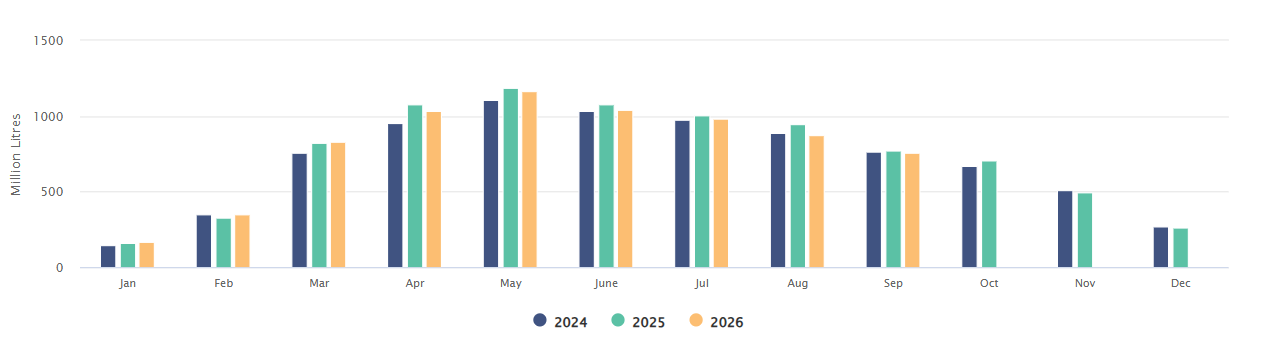
Domestic milk intake by milk processors and co-ops was estimated at 760.4 million litres in September 2026, according to the Central Statistics Office (CSO). According to the Milk Statistics September 2026 report, this is a decrease of 12.8 million litres or 1
 Agriculture
ESB Networks Autumn Safety Series 2026: Stay vigilant around electricity
The changes due in weather over the coming weeks, along with the onset of shorter days, is no doubt increasing the pressure on farmers to get field work completed. This extra pressure brings its own safety risks, and ESB Networks is asking farmers to also be m
 Agriculture
What is the expert advice for dry-off?
It is hard to think that dry-off is only around the corner, but there is no denying how quickly it is creeping up, so it is best to get prepared now. Realistically, a lot of farmers do not think about drying-off procedures until it is time to actually carry ou
 Agriculture
Genetic Jewels sale to feature 65 in-lamb Charollais on November 7
Blessington Mart in Co. Wicklow is set to host the Genetic Jewels sale on Saturday, November 7. A total of 65 in-lamb pedigree Charollais hoggets and ewe lambs are catalogued and the sale “promises to be an excellent chance to obtain some of the best Charollai
Never miss a headline
The biggest stories in business and finance, delivered to your inbox. Join thousands of readers — unsubscribe any time.