Should the govt take a long-term approach to tackling agri crises?
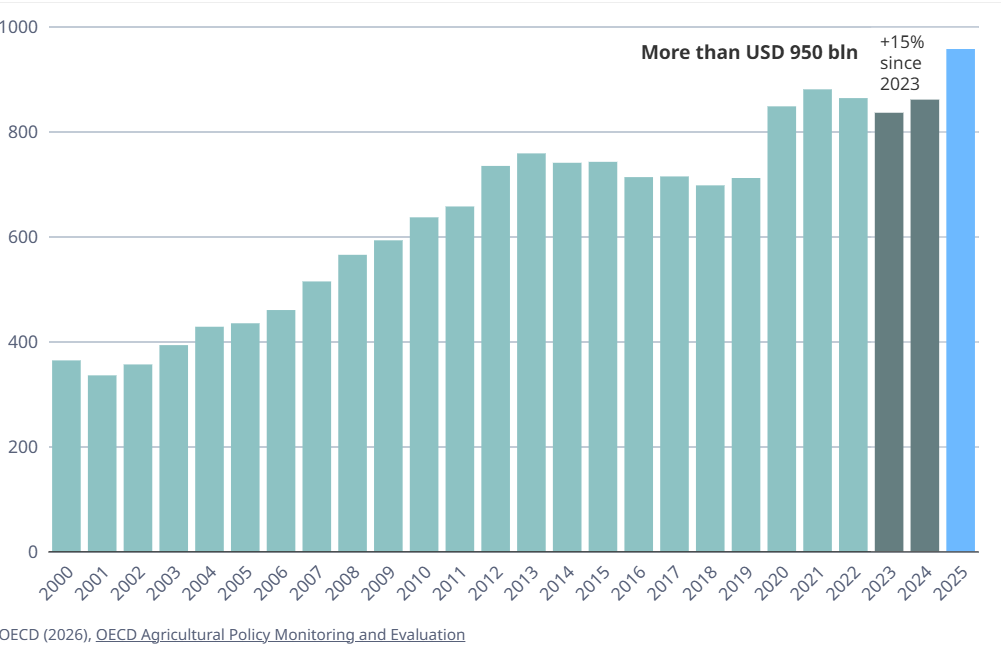
The agricultural sector is facing more frequent and interconnected global shocks, with increasing economic impact.
Against this backdrop, global government support to agriculture has increased, exceeding $950 billion in 2025, up nearly 15% since 2023.
Today (Monday, November 2), the OECD has launched a report – Agricultural Policy Monitoring and Evaluation 2026 – which examines how governments are responding to these developments.
The report identifies opportunities to make agricultural support more effective, forward‑looking and better aligned with resilience, productivity, and sustainability.
Government support to agriculture increased by nearly 15%, or more than $121 billion, between 2023 and 2025.
According to the OECD, this increase has reversed a long‑term decline relative to production.
This comes as agriculture faces more frequent and interconnected global shocks, with increasing economic impact.
Yet, the OECD has found that while this calls for predictable and forward‑looking policies, governments often use reactive, short‑term measures in response to successive crises.
Not keeping pace
Agricultural productivity growth is slowing, while public investment in the systems that support long‑term resilience and productivity is failing to keep pace, according to the report.
Spending on general services such as infrastructure, research, and innovation averaged $118 billion annually in 2023‑2025, across the 56 countries covered.
Agricultural support reached more than €950 billion in 2025 . Total support to agriculture jumped from 2023 to 2025, USD billion. Source: OECD
However, it fell from 4.6% to 2.4% of agricultural production since the early 2000s.
The report indicates that investment in agricultural knowledge and innovation systems now amounts to around 0.5% of sector value, roughly half the level observed in 2000‑2002.
Consumer costs
The report outlines how agricultural support affects consumers as well as farmers.
Policies that raise domestic food prices mean consumers also bear part of the cost of agricultural support, outweighing direct support they receive in some countries.
Across the countries covered, consumers were implicitly taxed by an estimated $204 billion per year through agricultural support policies in 2023‑2025, equivalent to 4.4% of consumer spending at primary product prices.
What should governments do?
The OECD is urging governments to take a more pro-active preventative approach, rather than continuing to respond to crises after they have begun.
It outlines some measures which it considers important:
Reduce distortive support and target policies more effectively;
Reinforce risk preparedness to minimise the need for ad hoc crisis responses;
Invest more in long-term resilience through research, innovation, and infrastructure;
Better align agricultural policies with sustainability objectives.
The OECD has said that governments should reduce reliance on policies that distort production, prices and trade, while replacing them with targeted risk management tools and outcome‑orientated incentives.
The aim would be to improve the effectiveness of public spending while strengthening resilience, productivity and sustainability.
Also, the report suggests that governments should help agriculture anticipate, adapt and respond to future shocks.
“Stable and predictable policy frameworks and open international markets can strengthen resilience and help safeguard food security, reducing the need for short‑term, ad hoc support measures,” the report stated.
In response to a question about the importance of the Common Agricultural Policy (CAP) from Agriland , senior agricultural policy analyst for the OECD, Martin Von Lampe said: “Food security is a shared objective across OECD countries, but the EU has the additional challenge of finding how to combine national flexibility with joint action.
“The Common Agricultural Policy gives member states room to adapt support to their own farming syst
Source: Agriland. Summary reproduced for informational purposes.
Related
 Agriculture
Domestic milk intake down almost 13 million litres in September
Domestic milk intake by milk processors and co-ops was estimated at 760.4 million litres in September 2026, according to the Central Statistics Office (CSO). According to the Milk Statistics September 2026 report, this is a decrease of 12.8 million litres or 1
 Agriculture
ESB Networks Autumn Safety Series 2026: Stay vigilant around electricity
The changes due in weather over the coming weeks, along with the onset of shorter days, is no doubt increasing the pressure on farmers to get field work completed. This extra pressure brings its own safety risks, and ESB Networks is asking farmers to also be m
 Agriculture
What is the expert advice for dry-off?
It is hard to think that dry-off is only around the corner, but there is no denying how quickly it is creeping up, so it is best to get prepared now. Realistically, a lot of farmers do not think about drying-off procedures until it is time to actually carry ou
 Agriculture
Genetic Jewels sale to feature 65 in-lamb Charollais on November 7
Blessington Mart in Co. Wicklow is set to host the Genetic Jewels sale on Saturday, November 7. A total of 65 in-lamb pedigree Charollais hoggets and ewe lambs are catalogued and the sale “promises to be an excellent chance to obtain some of the best Charollai
Never miss a headline
The biggest stories in business and finance, delivered to your inbox. Join thousands of readers — unsubscribe any time.